
Should I renovate or move in North Atlanta?
Start by comparing what you pay on your mortgage today with what you would pay after renovating or moving. A second loan can keep a low first-mortgage rate in place. A cash-out refinance replaces that loan, and a move means paying it off and financing the next home separately.
By Liron Ohana, Real Estate Advisor, The Ohana Real Estate Group ·
The question usually arrives as a comparison of two prices: what the renovation would cost against what a bigger house would cost. I’d start somewhere else, with the mortgage you already have, because keeping a low rate can materially change the monthly comparison.
Why does your current mortgage rate decide this?
Selling pays off your existing mortgage. Your next loan depends on the purchase price and how much you put down. When the new rate is higher, you can pay more per month even after putting your sale proceeds toward the next home.
In the second quarter of 2026, 65.6% of outstanding closed-end fixed-rate mortgages on one to four family homes carried a rate below 5%, and 49.1% were below 4%, on FHFA National Mortgage Database figures. The Freddie Mac 30-year average was 7.18% as of November 5, 2026, down from 7.24% the week before and up from 6.22% a year earlier.
That gap between existing and new rates is a reason to compare the financing before deciding.
What do the four options actually cost a month?
Here is the comparison as a hypothetical, with the assumptions stated so you can change them. Assume a North Atlanta home worth $700,000 with a $350,000 mortgage balance at 3.5%, a renovation quoted at $150,000, and a move up to a $900,000 house. Assume 30 years remaining on the first mortgage, a 20-year amortizing second loan at an illustrative 7.49%, and 30-year terms at 7.18% for the refinance and replacement mortgage. At 7% selling costs, the sale leaves $301,000 after mortgage payoff. Applying that to the $900,000 purchase leaves a $599,000 loan before buyer closing costs. The table compares principal and interest only. Add taxes, insurance, HOA dues, closing costs, and moving expenses separately.
| What happens to the debt | Monthly principal and interest | |
|---|---|---|
| Stay as you are | $350,000 stays at 3.5% | about $1,572 |
| Renovate, keep the first mortgage, add a second | $350,000 at 3.5% plus $150,000 at 7.49% | about $2,779 |
| Renovate with a cash-out refinance | $500,000, all of it at 7.18% | about $3,387 |
| Sell and move up to $900,000 | about $599,000 at 7.18% | about $4,058 |
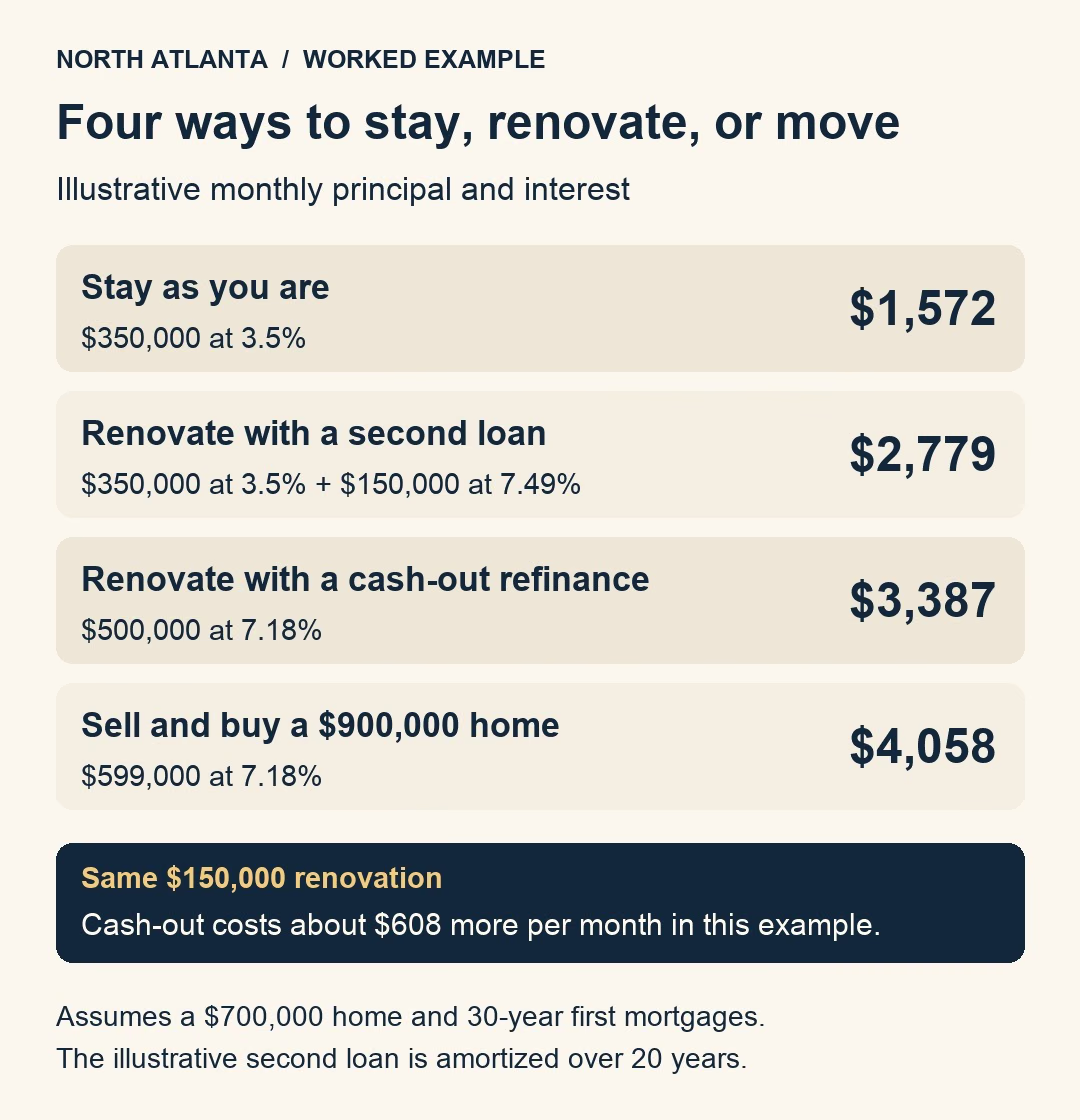
The financing choice changes the monthly payment even when the renovation scope stays the same.
Start with the gap between the two renovation rows. Same $150,000, same work, about $608 a month apart, roughly $7,300 a year. The cash-out refinance costs more because it replaces the whole first mortgage at today’s rate, so the $350,000 you were paying 3.5% on reprices to 7.18% along with the new money. A second loan or a line of credit borrows only the new money and leaves the first mortgage alone. A HELOC generally has a variable rate and may have a different repayment schedule. Ask the lender for the actual payment terms.
In this example, moving costs about $1,279 a month more than renovating with a second. That is roughly $77,000 in additional principal and interest payments over five years under these assumptions. It measures cash flow. Equity, transaction costs, and ongoing ownership expenses also matter.
When is moving still the right answer?
When the house cannot become what you need, at any price. A renovation can add a room, open a kitchen, finish a basement. It cannot move you closer to work, change the lot, add a floor the foundation will not carry, or fix a street you have stopped enjoying. If what is wrong is the location or the land, no budget fixes it and the rate comparison is beside the point.
It is also the right answer when the work needed is large enough to overbuild for the street. Spending $200,000 on a house whose block tops out well below the result is a way to lose money slowly, so compare the planned cost with recent sales of similar homes on the street.
And it can be right when the equity does more for you somewhere else. On the numbers above, selling frees roughly $301,000 after costs. That is a real down payment, so compare actual listings and recent sales in the North Atlanta neighborhoods you would consider.
How should I actually run this comparison?
In this order, because the first step changes the rest.
- Find your current rate and balance, and have your lender quote both a cash-out refinance and a second loan on the same amount. Ask for the monthly figure on each, not the rate alone.
- Get a real contractor bid, not an estimate from a website. A renovation cost is specific to your house, your finishes and this year’s labour, and it is the one number in this comparison nobody can look up for you.
- Price the move in full: the new payment at today’s rate, selling costs, moving costs and the months of overlap.
- Only then compare, and compare monthly totals rather than prices.
I’d also run the comparison with a higher renovation budget before signing a contract. A 20% overrun on a $150,000 project adds $30,000. Check how you would cover that amount and what it would do to your monthly payment.
A note on resale value, since it comes up. If you will live in the house for another ten years, a renovation is not an investment and the percentage recouped at resale is not the test. You are buying ten years of using your own home differently. Judge it that way, and ask the resale question only about work that would be strange for the street.
So which one is it?
Renovate when you like where you live, the lot works, your current rate is worth keeping, and the change you need fits the house without overbuilding for the block. Move when the house cannot become what you need, when the work would overbuild, or when the location itself is the problem.
That is the same conclusion we reached on our Keller Williams blog in August, and the arithmetic above is why it holds: keeping a low first-mortgage rate can materially lower the monthly cost of renovating.
If you are weighing the two, I’d rather look at both with you than have you pick from a spreadsheet. Send me your address and a rough idea of the work you are considering, and I’ll give you a market-based value for the house as it stands, what it could be worth improved, and what is actually available in the areas you would move to. You can see how I work with sellers and buyers across North Atlanta, the areas we cover if a move is on the table, and if the answer turns out to be moving, the home value tool is a reasonable first look before we talk. If the answer turns out to be staying put and the question is really about the payment, the price cut or rate buydown article covers how those two levers differ.
Sources
- Freddie Mac Primary Mortgage Market Survey: 30-year fixed-rate average 7.18% as of November 5, 2026, down from 7.24% the prior week and 6.22% a year earlier. November 5 survey release, accessed November 6, 2026.
- FHFA National Mortgage Database, Q2 2026, closed-end fixed-rate first-lien one to four family mortgages outstanding: 49.1% below 4%, 65.6% below 5%, 22.5% above 6%. Reported by Calculated Risk, October 1, 2026. calculatedrisk.substack.com, accessed November 6, 2026.
- Bankrate national lender survey: average HELOC rate 7.49% as of November 4, 2026, up 13 basis points on the week. The survey uses a $30,000 line. This example borrows the rate as an assumption for a $150,000 amortizing second loan, and actual quotes and terms can differ. bankrate.com, accessed November 6, 2026.
- The Ohana Real Estate Group, “Renovate or Relocate? How North Atlanta Homeowners Are Navigating the Mid-August Crossroads”, Keller Williams blog, August 15, 2026 (the stay-or-go framing).
- Worked example is hypothetical: a $700,000 home with $350,000 remaining at 3.5% on a 30-year term, a $150,000 renovation, a $900,000 replacement home, selling costs at about 7%, a second loan at 7.49% over 20 years and first-mortgage financing at 7.18% over 30 years. Principal and interest only.
This article is general information, not lending, tax or legal advice. Rates move weekly and a HELOC rate is usually variable; your own figures will differ. Get quotes from your lender and a written bid from a licensed contractor before deciding.
— Liron Ohana, Residential & Relocation. Talk to us.