
Price cut or rate buydown: which sells a home faster in Alpharetta?
Neither is faster on its own. In Alpharetta a seller-paid rate buydown helps when buyers are touring but not writing offers, and a price cut helps when buyers are not coming at all. The two can cost the seller the same amount at closing; they send different signals and fix different problems.
By Liron Ohana, Real Estate Advisor, The Ohana Real Estate Group ·
A listing that has gone quiet in Alpharetta usually gets one of two suggestions: cut the price or offer to buy down the buyer’s rate. Before you choose, I’d slow down and look at one thing: your showing log. It tells you which problem you have, and the two tools solve different problems.
What happens when a price cut and a rate buydown cost the seller the same amount?
Because the seller writes the same check either way, but the buyer feels it in completely different places. A price cut lowers the loan amount, so it trims the payment a little, for thirty years. A buydown lowers the payment a lot, for two years, then disappears. Same cost to you; a different experience for the person deciding whether to write an offer.
Here is the arithmetic at the current rate, as a hypothetical. Assume a home listed at $800,000, a buyer putting 20% down on a $640,000 loan, and a 30-year rate of 7.40%, which is the Freddie Mac national average for the week ending October 8, 2026. Your buyer’s actual rate will differ; the comparison holds at any rate.
| 2-1 rate buydown | Price cut of the same amount | |
|---|---|---|
| Seller’s cost at closing | about $15,200 | $15,200 |
| Buyer’s loan (20% down) | $640,000 | $627,840 |
| Payment, year 1 (principal and interest) | about $3,594 | about $4,347 |
| Payment, year 2 | about $4,003 | about $4,347 |
| Payment, year 3 onward | about $4,431 | about $4,347 |
| Relief in year 1 | about $837 a month | about $84 a month |
| Relief over the life of the loan | about $15,200, all in the first two years | about $30,300, spread over thirty years |
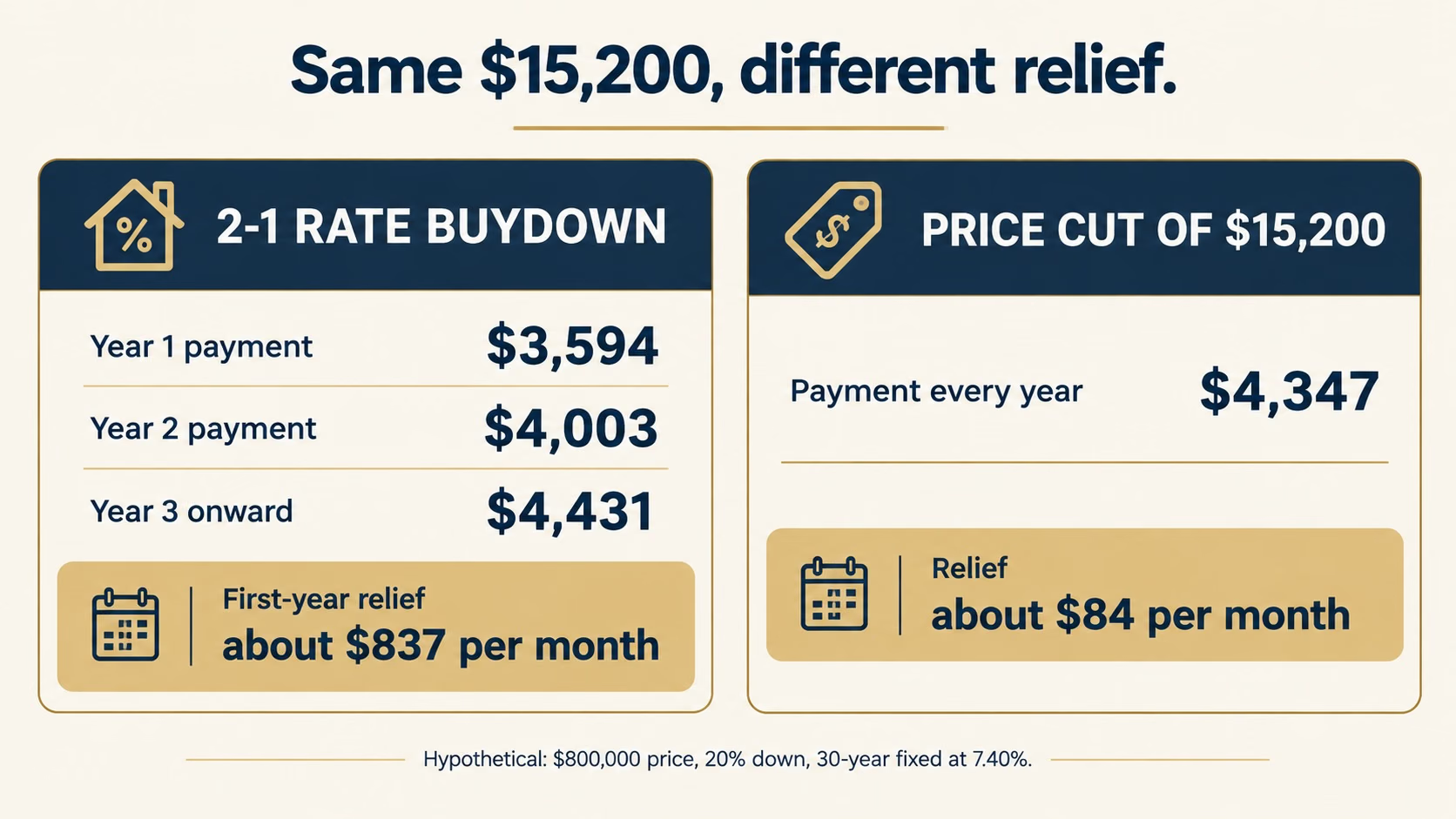
Two things stand out. First, to give the buyer the same first-year relief as the buydown through price alone, you would need to cut about $151,000, which no seller does. Second, the price cut catches up with the buydown after roughly fifteen years, so a buyer who plans to stay that long is better off with the cut, and a buyer who plans to refinance or move sooner is better off with the buydown. Neither is the right answer for every buyer, which is why the question is really about who is looking at your home and what is stopping them.
How do I know which problem my Alpharetta listing has?
Read your showings, not your feelings. This is the approach we laid out when we first wrote about this on our Keller Williams blog, and it has held up: the pattern of activity tells you what the market is saying before any offer does.
Steady showings and no offers can mean the monthly payment is part of the problem, especially when the feedback is otherwise positive. Many buyers here are moving from a mortgage in the fives or lower, and the jump to a payment in the four thousands is where they freeze. A buydown speaks to that directly, because it changes the number they will actually pay next year. It is worth ruling out the other explanations first, though: condition, layout, updates, how the home compares to what else is open that weekend, or what the home feels worth once a buyer is standing in it.
Few or no showings points more strongly to price, presentation, or how the home compares online. Buyers are filtering you out on price, photos, condition or location before they ever book, so they never get far enough to care about the payment. A buydown does little here, because nobody is in the house to hear about it. The price cut, or a change to how the home is presented, is what brings them through the door.
For context, Alpharetta is a market where both patterns are common right now. In August 2026 the median sale price was $789,478, down 1.6% from a year earlier, homes took a median of 37 days to go under contract, 42.3% of listings had at least one price drop, and homes sold at 98.8% of list on average, according to Redfin’s Alpharetta market data. Price drops are normal here. A price adjustment does not necessarily mean something is wrong with the home. It can simply mean the market responded differently than expected.
What should a seller check before offering a buydown?
Three things, all with the buyer’s lender, before the buydown goes into the listing remarks.
- Qualification. Under Fannie Mae’s guidelines the lender qualifies the buyer at the full note rate, not the reduced rate. A buydown lowers the payment a qualified buyer makes; it does not turn a buyer who cannot qualify into one who can.
- Eligibility and the cap. Fannie Mae allows a temporary buydown on a principal residence or a second home. Investment properties are not eligible, so a buyer purchasing your home as a rental cannot use one. Where it is allowed, the buydown counts as a seller contribution, and total seller contributions are capped at 3% of the price above 90% loan-to-value, 6% from 75.01% to 90%, and 9% at 75% or below. In the example above, $15,200 is about 1.9% of the price, well inside the 6% cap for a buyer putting 20% down. Other programs have their own rules, which the buyer’s lender will confirm.
- The structure. Fannie Mae allows a temporary buydown to lower the rate by up to 3 percentage points, stepping up no more than 1 point a year, over at most three years. The 2-1 structure is the common one; a 1-0 costs less and does less. The buyer’s lender prices it, not the seller.
If the lender’s answers hold, the buydown can be offered as a concession in the contract. If they do not, you have saved yourself a promise you could not keep.
What does this look like when the listing is yours?
When a seller calls me about a home that has gone quiet, the first thing we do together is pull the showing report for the last two weeks and the feedback that came with it. That ten-minute conversation usually makes the decision for us. If the showings are there and the offers are not, we talk to a lender about what a buydown would cost on your price and put it in front of the buyers who have already been through. If the showings are not there, we talk about price and presentation plainly, because no concession reaches a buyer who never books.
A buydown is a strong tool for a specific problem. It is not a way to avoid a price conversation that the market is already having with you. That honest read is what I try to give every seller on the residential page, and it is the same one I give buyers in Alpharetta who are deciding what a payment they can live with really looks like, which is where buying in Alpharetta starts to feel harder than it should. If you are not sure what your home is worth today, the home value tool is a reasonable place to start before any of this.
If your Alpharetta listing has gone quiet, send me the address and the number of showings you have had in the last two weeks, and I’ll tell you which problem you actually have before you spend a dollar on either fix.
Sources
- Freddie Mac Primary Mortgage Market Survey, 30-year fixed-rate average 7.40% for the week ending October 8, 2026 (up from 7.28% the prior week). freddiemac.com/pmms, accessed October 9, 2026.
- Redfin, Alpharetta GA housing market, August 2026: median sale price $789,478 (down 1.6% year over year), median 37 days on market, 42.3% of homes with a price drop, 98.8% sale-to-list. redfin.com, accessed October 9, 2026.
- Fannie Mae Selling Guide B2-1.4-04, Temporary Interest Rate Buydowns (last updated August 7, 2024): eligible on principal residences and second homes, investor properties ineligible; borrower qualified at the note rate; maximum 3-point reduction, 1-point annual step, 3-year term. selling-guide.fanniemae.com, accessed October 9, 2026.
- Fannie Mae Selling Guide B3-4.1-02, Interested Party Contributions (last updated May 7, 2025): for principal residences and second homes, financing concession caps of 3% above 90% LTV, 6% at 75.01–90%, 9% at 75% or below; buydown funds count toward the cap. selling-guide.fanniemae.com, accessed October 5, 2026.
- The Ohana Real Estate Group, “Price Cut or Rate Buydown: What Sells Faster in Alpharetta?”, Keller Williams blog, September 11, 2026 (the showings-based diagnosis).
- Worked example is hypothetical: $800,000 price, 20% down ($640,000 loan), 30-year fixed at 7.40%, 2-1 buydown; payments are principal and interest only.
This article is general information, not lending, legal or tax advice. Rates, lender guidelines and contribution caps change; confirm the current figures with the buyer’s lender before offering any concession.
— Liron Ohana, Residential & Relocation. Talk to us.