
How do I analyze a North Atlanta rental property?
Start with four numbers: achievable rent, your estimated property taxes, financing, and reserves. Rebuild the tax estimate before making an offer. The listing can reflect a homestead tax break you generally won’t get if you rent out the home.
By Jerry Cohen, Real Estate Advisor, The Ohana Real Estate Group ·
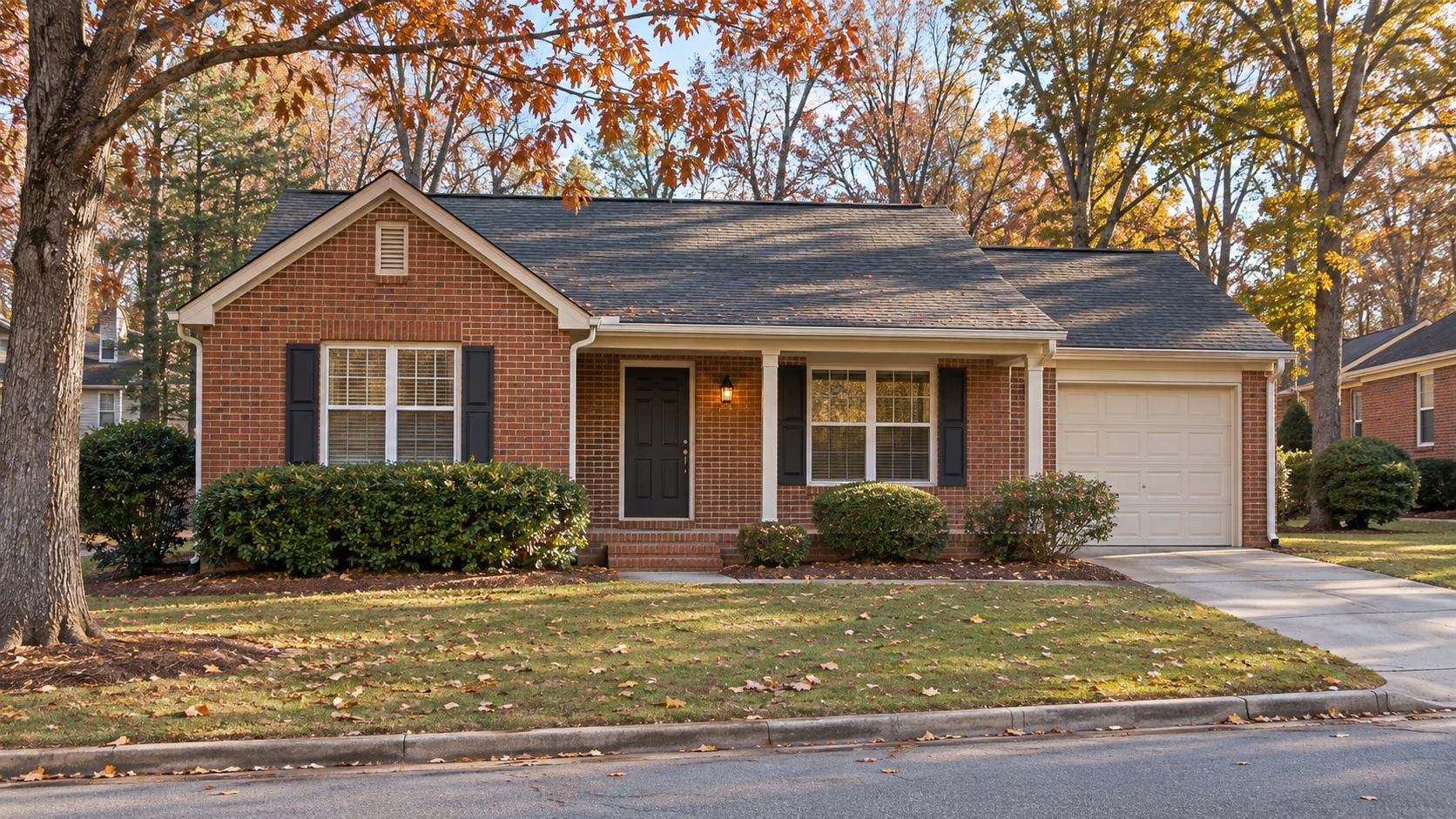
When I look at a rental, the first line I double-check is property tax. The listing can show what the seller paid with a homestead exemption. If you plan to rent out the house, build a fresh estimate before you make an offer.
Which numbers actually decide a North Atlanta rental?
Four to start. Rent supported by nearby comparable leases, a property tax estimate, your loan terms, and a reserve for vacancy and repairs.
The list is short because in a market like this one the answer rarely turns on the small items. It turns on rent, tax and the loan. Insurance, management and HOA dues where applicable still belong in your final numbers, but a missing $40 a month will not change the decision when those three are right.
Why can your property taxes differ from the listing?
The listing can show what the seller paid with a homestead exemption. Your estimate should reflect how you plan to use the property.
Georgia’s base-year homestead exemption can limit increases in the taxable assessed value for a qualifying primary residence. The seller’s exemption does not carry over to you. O.C.G.A. § 48-5-44.2(b)(2) states that “no exemption provided for in this subsection shall transfer to any subsequent owner of the property, and the assessed value of the property shall be as provided by law.” A house you buy and rent out in full generally won’t qualify for a primary-residence exemption at all.
Georgia generally assesses property at 40% of the fair market value determined by the county. Your purchase price can be a starting point for an estimate. Ask the county assessor about the parcel’s valuation and the tax office about the applicable levies and exemptions.
Suppose you buy a $525,000 house in Forsyth County and rent it for $2,900 a month. Assume a seller taxable assessed value of $150,000 and a county market value of $525,000 for the buyer. For illustration, apply the same 2025 Forsyth County rate of 24.522 mills to both rows. Actual taxable values can differ by levy. Differences are calculated before rounding.
| Illustrative taxable assessed value | Tax per year | Tax per month | |
|---|---|---|---|
| Seller with assumed exemption | $150,000 | about $3,678 | about $307 |
| Rental buyer at 40% of assumed $525,000 market value | $210,000 | about $5,150 | about $429 |
| The difference | about $1,471 | about $123 |
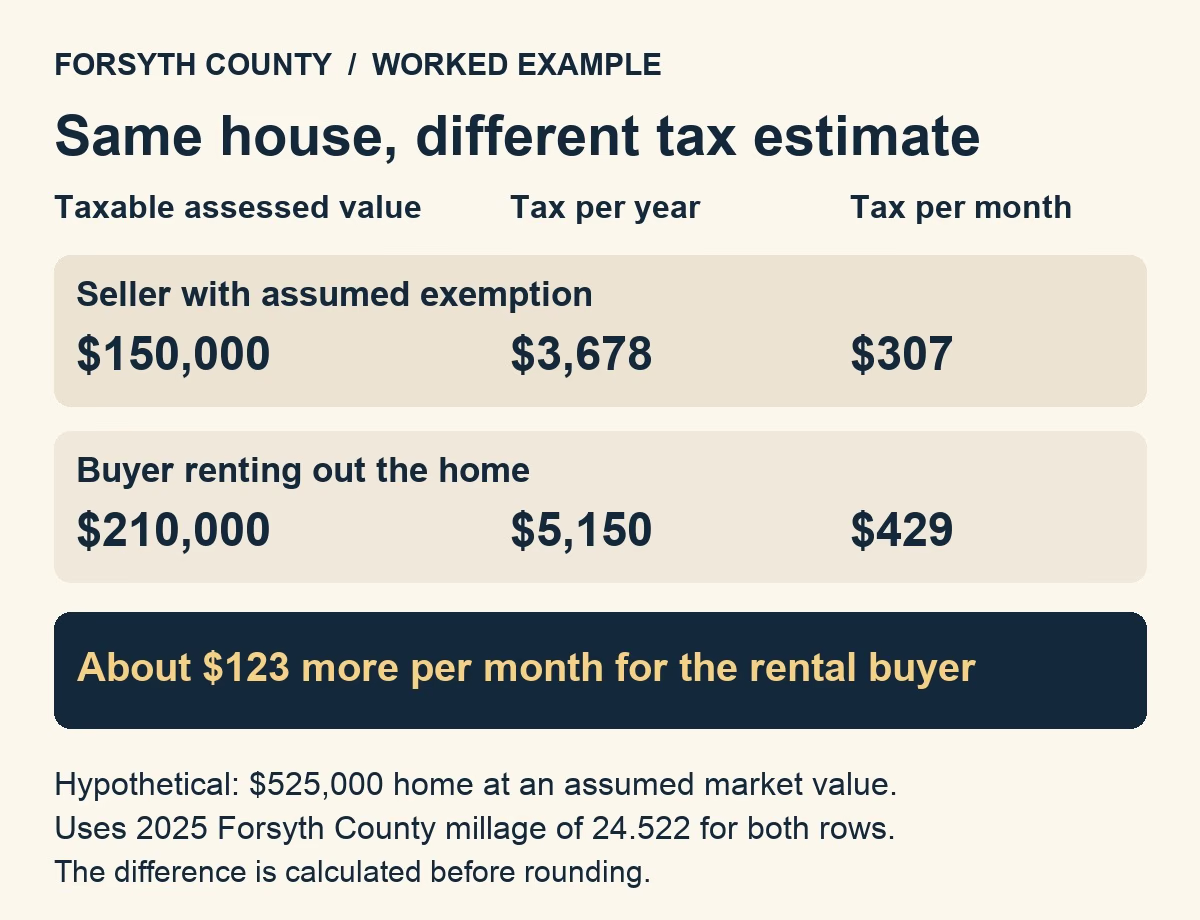
In this example, using the seller’s tax figure would leave you budgeting about $123 a month too little.
What does the whole calculation look like?
Same house, 25% down, and a 30-year fixed loan at 7.11%, using Freddie Mac’s November 12, 2026 purchase mortgage average as a benchmark. Get an investor-loan quote for the property you’re analyzing. Assume one month of vacancy, as in the 1% rule article.
| Per year | |
|---|---|
| Gross rent at $2,900 a month | $34,800 |
| Less vacancy, one month | $2,900 |
| Less property tax, your bill | $5,150 |
| Less principal and interest on a $393,750 loan | $31,785 |
| Before insurance, maintenance and management | about $5,035 negative |
That is a negative number, and I am showing it rather than hiding it because it is the honest result for a house renting at 0.55% of its price. Insurance, maintenance and management then come off that, and those three are quotes you collect rather than figures anyone can look up for you. Get a landlord policy quote, price the roof and the HVAC by their age, and budget management even if you intend to self-manage, because one day you will not.
So is a deal like that simply bad?
A year-one cash shortfall tells you how much you need to carry. Weigh that against your reserves, your other options, and how long you plan to own the property.
In year one, about $3,916 of the mortgage payments goes toward principal and builds equity. You still need to cover the full cash shortfall plus the expenses this example leaves out. Treat future rent growth and changes in property value as scenarios.
If the purchase only works after rents rise, run it again with rents flat and a larger repair reserve.
What actually changes the answer?
The down payment, more than anything else you control. Same house, same rent, same tax bill, three financing positions:
| Down payment | Loan | Principal and interest | Per year, before insurance, maintenance, and management |
|---|---|---|---|
| 25% | $393,750 | about $2,649 a month | about $5,035 negative |
| 35% | $341,250 | about $2,296 a month | about $797 negative |
| 50% | $262,500 | about $1,766 a month | about $5,560 positive |
Nothing about the house changed between those rows. That is worth sitting with, because buyers often reject a property when what they are really rejecting is a loan structure. Whether tying up that much more cash is the right call depends on what else the money would do, which is a different conversation and a real one.
The other lever is the rent, and it is smaller than people hope. Getting $100 a month more than you assumed adds $1,100 with one month vacant, useful but not transformative. Getting the rent assumption wrong by $300 because you used a city average instead of what the street achieved is how a thin deal becomes a losing one.
How should I run this on a specific house?

Get the rent from what comparable homes nearby actually leased for and how long they sat, not from a city figure. Ask the county for a tax estimate for the parcel as a rental. Get a real insurance quote. Then put the four numbers in one place and look at the annual figure, not the monthly, because monthly numbers flatter deals and annual numbers do not.
If it comes out negative, that is information rather than a verdict. Decide whether you can carry it comfortably even if rents stay flat. That is the analysis I run with clients on the investors page, and it is the same discipline behind the occupied rental article: the number on the listing is rarely the number that decides it.
If you are looking at a specific house in North Atlanta, send me the address and what you think it rents for, and I’ll run these four numbers on it before you write an offer.
Sources
- O.C.G.A. § 48-5-44.2(b)(2) and (c), base-year homestead exemption and transfer provisions. See the Georgia Code and 2026 amendments in SB 33, accessed November 13, 2026.
- Georgia Department of Revenue, Property Tax FAQ: “Assessed value is 40% of the fair market value.” dor.georgia.gov, accessed November 13, 2026.
- Forsyth County adopted 2025 millage rates, total 24.522 mills including school levies, used here as an illustration only. Forsyth County’s adopted 2025 millage rates, accessed November 13, 2026.
- Freddie Mac Primary Mortgage Market Survey: 30-year fixed-rate average 7.11% as of November 12, 2026, down from 7.18% the prior week. Freddie Mac survey archive, accessed November 13, 2026.
- Worked example is hypothetical: a $525,000 house renting at $2,900 a month, an assumed seller taxable assessed value of $150,000, Forsyth County 2025 total millage, 30-year fixed at 7.11%, vacancy at one month a year, non-owner-occupied with no homestead exemption. Figures are principal, interest, tax and vacancy only, before insurance, maintenance and management.
This article is general information, not legal, tax or lending advice. Assessment practice, millage rates and exemptions vary by county and change year to year; confirm your own figures with the county board of assessors, your lender, your insurer and a CPA.
— Jerry Cohen, Real Estate Investment Strategy. Talk to us.