
Should I buy an occupied rental in Alpharetta, and what matters more than price?
Yes, an occupied rental in Alpharetta can be a sound purchase when the lease supports the price. Three verified numbers matter more than the asking price: the rent actually paid, the payment history and the security deposit. Verify them before you give up any due diligence time.
By Jerry Cohen, Real Estate Advisor, The Ohana Real Estate Group ·
Yes, an occupied rental in Alpharetta can be a sound purchase when the lease supports the price. Three verified numbers matter more than the asking price: the rent actually paid, the payment history and the security deposit. Verify them before you give up any due diligence time.
Most buyers walk into an occupied rental thinking about the price. I’d slow down. The price is the number you negotiate once. The lease is the number you live with every month until it ends.
What do you actually buy when you buy an occupied rental in Alpharetta?
You buy the house and, in most cases, the tenant’s lease as it was signed. Georgia’s Landlord-Tenant Handbook, published by the Georgia Department of Community Affairs, says new owners are generally subject to existing leases and cannot raise rents or change rules. After closing, you generally step into the landlord’s position under the existing lease, which is why the lease, its addenda and any documented concessions need to be reviewed before closing. Some leases include a clause about what happens on a sale, so the lease itself is the first thing to read, and a Georgia real estate attorney is the person to confirm how it applies to your contract.
Three things come with the keys:
- The rent on the lease, and the rent the tenant actually pays, which are not always the same number.
- The payment history, which tells you whether the rent arrives on the first or on the twentieth.
- The security deposit, and the question of where it is and who holds it after closing.
What happens to the security deposit when the property is sold?
Georgia’s Landlord-Tenant Handbook (Georgia Department of Community Affairs, revised August 29, 2024) says that if the property changes owners, the former owner must either transfer the security deposit to the new owner, who becomes responsible for it, or refund it to the tenant. One of those two things has to happen. Which one will happen, the amount being transferred, and how the tenant will be notified should all be handled clearly before closing.
One Georgia-specific wrinkle. Georgia’s escrow requirement for deposits, O.C.G.A. 44-7-31, does not apply to an owner who holds ten or fewer rental units and manages them without a paid third party, under O.C.G.A. 44-7-36. That describes a lot of sellers here. So the deposit may be in a personal account rather than an escrow account, and the first question to ask is simply where it is. Then ask for the move-in inspection list if one exists, because you may be the one settling that deposit at move-out.
Why does the rent actually paid matter more than the asking price?
Because a small monthly gap costs more than the price concession most buyers fight for. Here is a hypothetical, with the assumptions stated so you can change them.
Assume a $500,000 Alpharetta house with a lease at $2,800 a month. During due diligence the ledger shows the tenant has paid $2,600 since spring because the seller agreed to a concession in a text message. Assume you finance 75% at 6.5% over 30 years.
| Lease says | Tenant actually pays | |
|---|---|---|
| Monthly rent | $2,800 | $2,600 |
| Annual rent | $33,600 | $31,200 |
| Annual cash-flow effect of the gap | about $2,400 less |
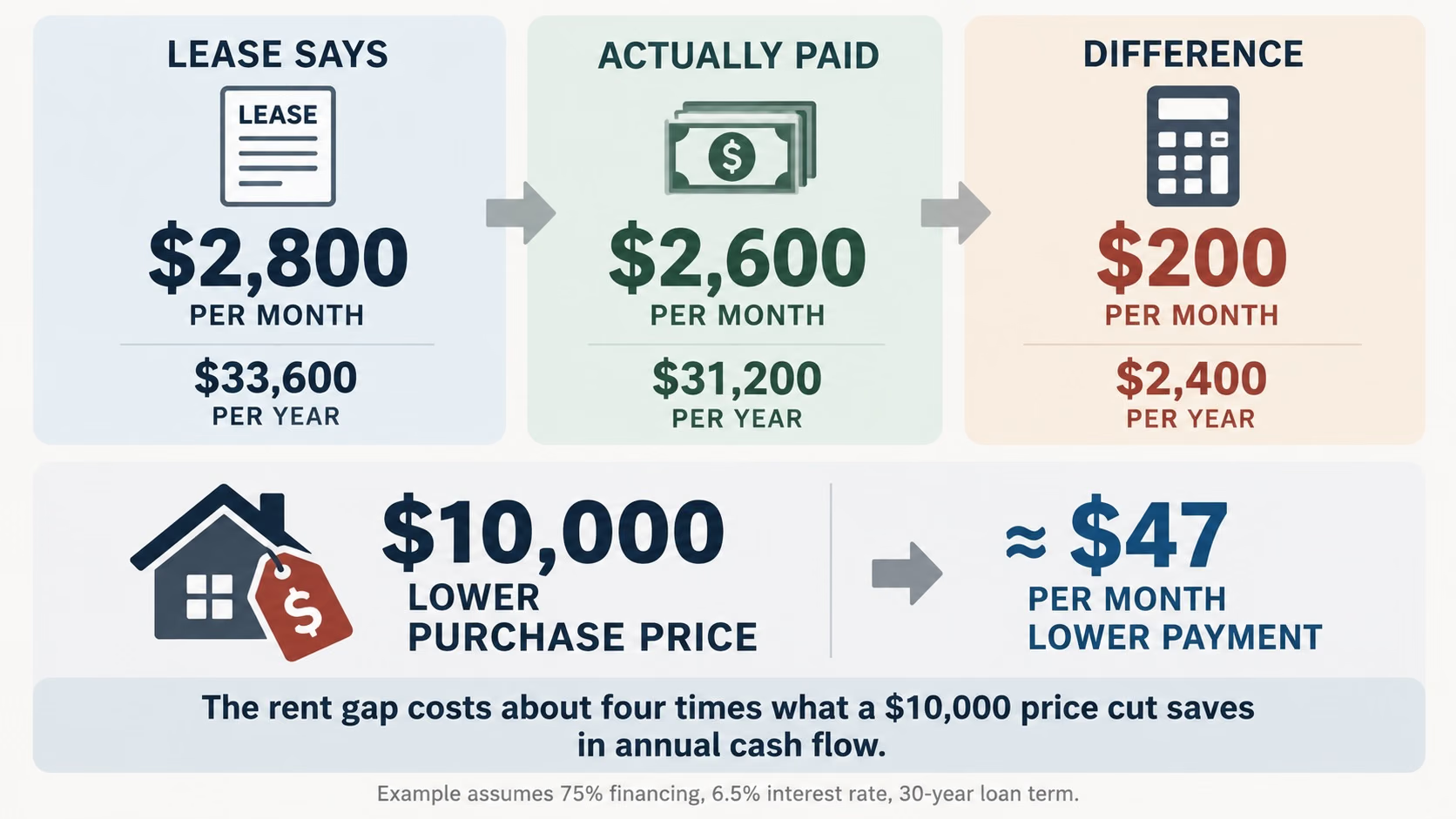
Now compare that to a $10,000 price reduction on the same deal. With 75% financing, $10,000 off the price means $7,500 less borrowed, which lowers the monthly payment by roughly $47 at 6.5%, about $570 a year, plus $2,500 less cash at closing. The rent gap costs you about $2,400 a year. The price cut saves you about $570 a year. One is roughly four times the other, and only one of them shows up in the listing.
What that gap is worth in purchase price is a judgment, not a formula. Alpharetta single-family homes are priced on comparable sales, not on a cap rate, so I would not tell you the house is “really” worth some lower number. I would tell you that your underwriting has to use the rent that is actually arriving, that the lease renewal date is now the most important date in the file, and that the gap is a legitimate negotiation point because the seller’s numbers were wrong. If you are wondering why the ratio between rent and price is thin in Alpharetta to begin with, I covered that in the 1% rule article.
What should I verify before I write an offer on an occupied rental?
Verify four documents, then make sure the three rent figures agree.
- The complete signed lease, every page, every addendum, and any sale or early-termination clause.
- Twelve months of the payment ledger, or the seller’s bank deposits for the rent.
- A tenant estoppel letter: a one-page statement, signed by the tenant, confirming the rent, the deposit amount, the lease end date, and any concessions or repairs promised.
- The deposit: the amount, where it is held, whether it transfers to you or is refunded to the tenant, and how the tenant will be notified.
Then compare the lease, the ledger and the estoppel letter. If all three say $2,800, you have a $2,800 rental. If they do not match, stop and reconcile the discrepancy before you underwrite the property. A gap can be a verbal concession that is still running, a concession that already expired, a partial month, or a documented repair credit. Each of those leads to a different number, and the reason matters as much as the gap.
Years ago I reviewed a rental application that looked fine at first. When I verified the documents independently, they did not hold up, and I declined the application. The lesson stayed with me: documents are the beginning of verification, not the end of it. The same rule applies when you are the buyer and the seller hands you a lease.
Should I shorten due diligence to make my offer stronger?
Protect enough due diligence time to complete the verification you need. Shortening it to look competitive is the trade I see buyers make most often, and on an occupied rental it is the one I’d push back on hardest.
In a competitive situation, the instinct is to cut the due diligence period down to a few days, or to waive it, so the offer looks cleaner. On a vacant house that is a risk you can price. On an occupied rental the due diligence window is usually the only time you can request the ledger, get the estoppel letter signed and walk the house with the tenant present. How many days that takes depends on how responsive the seller and tenant are, so ask for the ledger and the estoppel letter before the offer if you can, and size the period to what is still outstanding.
If you want a stronger offer, strengthen the terms the seller cares about and keep the verification:
| Term | Costs you | Worth to the seller |
|---|---|---|
| Closing date that matches the seller’s plan | Little | A lot, especially if they are buying elsewhere |
| Financing underwritten before the offer, not just pre-approved | A week of paperwork | Certainty |
| Rent proration and deposit handling spelled out | Nothing | Fewer surprises at closing |
| A short tenant communication plan | Some coordination | A tenant who stays |
| Shortened due diligence | Your main verification window | Speed, which you can offer other ways |
Sellers of occupied rentals usually want two things: certainty that the deal closes, and no drama with the tenant. You can offer both without trading away the time you need to verify.
What does a good occupied-rental purchase in Alpharetta look like?
It looks slow at the start and quiet afterwards. You read the lease before the offer. You underwrite on the rent actually arriving, not the rent advertised. You keep enough due diligence time to finish the verification, and you use it. The deposit’s path is settled before closing. The tenant hears from you before closing, in a short letter that gives the rent, the address to send it to, and says that nothing else changes. If the lease has ended and the tenant is month to month, you know that Georgia requires 60 days’ notice from a landlord to end a tenancy at will under O.C.G.A. 44-7-7, and you plan around it.
Then you can judge the property for what it really is: a long-term investment whose performance will depend on the rent, the financing, tenant stability, expenses and what happens to the Alpharetta market over your hold period. That is how I approach every deal on the investors page, and it is why I spend more time on the lease than on the list price when a client sends me an occupied rental in Alpharetta.
If you are looking at one now, send me the address and the lease and I’ll help you look at what matters before you write the offer.
Sources
- Georgia Landlord-Tenant Handbook, Georgia Department of Community Affairs, revised August 29, 2024. dca.georgia.gov, accessed October 2, 2026.
- O.C.G.A. § 44-7-31 (security deposits held in escrow) and § 44-7-36 (exemption for owners of ten or fewer units who self-manage), Georgia Code 2025, via law.justia.com, accessed October 2, 2026.
- O.C.G.A. § 44-7-7 (notice to end a tenancy at will), Georgia Code 2025, via law.justia.com, accessed October 2, 2026.
- Worked example is hypothetical: $500,000 purchase, $2,800 lease rent, $2,600 rent paid, 75% loan at 6.5% over 30 years.
This article is general information, not legal, tax or lending advice. Handbook and statute references are to the Georgia Landlord-Tenant Handbook (revised August 29, 2024) and the Georgia Code as published for 2025, both accessed October 2026; confirm current law and how it applies to your contract with a Georgia real estate attorney.
— Jerry Cohen, Real Estate Investment Strategy. Talk to us.